
Outdoor Links
Hike Arizona
Trip Planning Guide
Trip Report Index
Calendar of Events
Library
|
Oak Creek Canyon Camping Sedona October 14-16, 2005 by Chuck Parsons |
|
|
On a cool and cloudy Arizona morning in mid-October, with the crisp and inviting bite of fall in the air, Barry Altschuler, Doug East, Joyce Parrish, Joe Orman, Sheila Grant, and hike leader Chuck Parsons gather near the West Fork Trailhead in Oak Creek Canyon for a quick group picture, before embarking on our three- mile hike into West Fork Canyon. We are on our second day of the first Arizona Trailblazers car camping trip in Oak Creek Canyon to celebrate and enjoy the beautiful fall weather in Red Rock Country and to hike one of the most spectacular and colorful trails in Arizona. In an area that defines the very essence of autumn in northern Arizona’s canyon country, we also hope to catch a number of trees along the West Fork of Oak Creek displaying their best fall colors. |
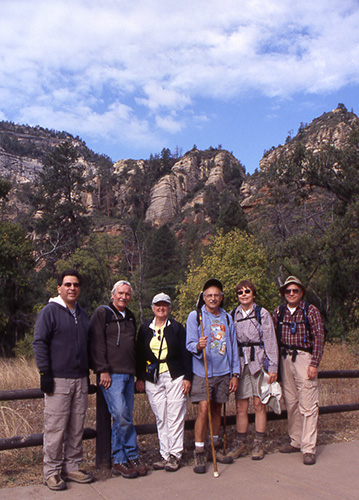 Barry, Doug, Joyce, Joe, Sheila, Chuck |
|
Seems that a lot of other people have decided that Saturday, October 15th, is the most perfect day to get out and enjoy the fall colors of Oak Creek Canyon. With the hiking traffic along the main trail starting to look more like a typical weekend on the Summit Trail to Piestewa Peak or the Peralta Trail to Fremont Saddle in the Superstitions, Joe Orman and I decide to avoid the crowds by getting off the trail and hiking alongside or right through the creek bed as much as possible. Since the water level is so low, this turns out to be a very practical solution and has the added advantage of putting us even closer to the best photo opportunities. This scene is less than a mile into the canyon, looking upstream at the heavy foliage that hugs the banks of the West Fork for most of its length, as it winds its way between the high canyon walls. We would take most of our best pictures of the day along this stretch of the creek. |
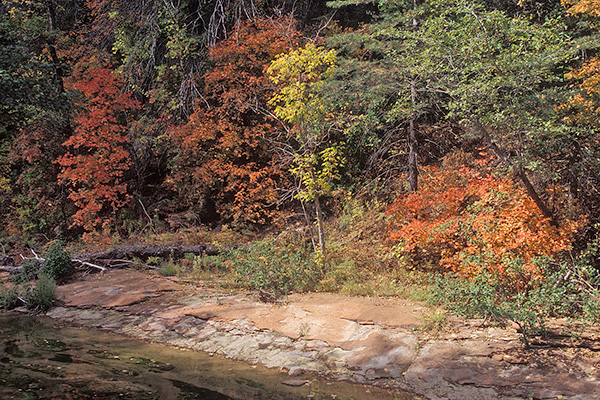 The spectacular fall colors of Oak Creek Canyon. |
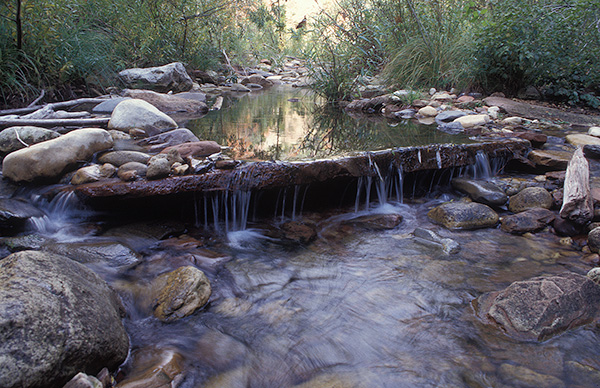 A quiet reflecting pool at one of the creek crossings. |
|
One of the joys of both hiking and photography is occasionally finding and experiencing the unexpected. Although I have hiked the West Fork Trail many times over the years, I don’t seem to recall ever seeing, much less photographing, this particular scene before and almost missed it once again in my haste to make up time and put more of the trail behind me. Unfortunately, we often get so absorbed in getting to our destination, that we overlook some of the little gems along the way. Photography, by its very nature, forces us to take a closer look at our surroundings and search out these often hidden gems. Taking a second and closer look at this scene on the way through, I noticed a nice reflection pool above the little waterfall cascading over the wide rock shelf in the creek bed and decided to take a picture and attempt to capture the reflection, if nothing else. Not really expecting a lot from this picture, I was pleasantly surprised when it turned out to be one of my favorite pictures from the hike. As we continue along the creek bed and move deeper into West Fork Canyon, Joe and I come across occasional obstacles from time to time that force us to either navigate around them or move back up to the main trail for a while. Deeper pools of water or nearly impassable debris fields from this spring’s flash flooding are the usual culprits, but we are usually able to work around them and find our way back down to the creek bed. Hiking the trail would obviously be much easier, but this route gives us many more picture opportunities, as well as peace and quite away from the growing crowds of hikers up on the main trail. We keep in contact with the rest of our group over our TalkAbout radios and make plans to re-join them later for lunch. |
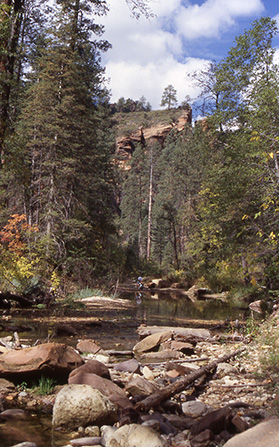 Hiking along the creek bed is even more scenic than the main trail. |
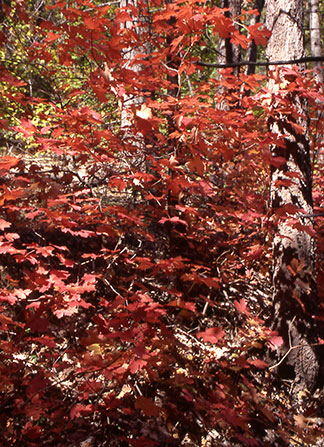 The signature big-tooth maples of Oak Creek Canyon blaze in their autumn glory! |
|
Some of the most magnificent fall colors in Arizona can be found throughout Oak Creek Canyon during October and early November, and the big-tooth maples that frequent the West Fork have to be at or very near the top of anyone’s list of the most spectacular of all fall colors. As the chill night air of fall settles into the canyon, and the temperatures begin to sink toward the freezing mark, a remarkable change begins to occur within the leaves of the big-tooth maple. The photosynthesis process gradually shuts down, and the leaves give up their chlorophyll of the summer, as they slowly begin to transform from green to orange to light red, before finally emerging with the deep crimson colors that so define the maple trees in fall. |
|
Doug surveys the scene from high atop a log jam blocking the trail, while Sheila, Joyce, and Barry look on, wondering “how are we supposed to get around this mess?” With the loud buzz of chain saws periodically breaking the tranquility of the canyon during our hike, we had stopped earlier to talk to a Forest Service crew clearing away fallen timber across the trail. |
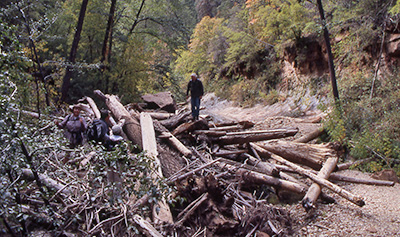 How the heck are we supposed to get around this? |
|
They stopped long enough to tell us about the massive spring flash flood that swept through West Fork Canyon this past March at a depth of between ten and twelve feet, ripping out trees up to two feet in diameter and effortlessly sweeping them and large boulders along the way like so many small sticks and pebbles. The awesome power of rushing waters confined between narrow canyon walls is almost too frightening to imagine, knowing that any living thing caught in its path would literally be smashed beyond recognition. Only with those terrible images in mind, can we begin to appreciate the powerful forces that created this monstrous tangle of timber, only one of many, in the canyon. |
|
Roughly two miles into the canyon we come across the first of several massive rock shelves overhanging the creek bed, creating an almost tunnel-like effect in some places. These so-called “wave caves” do look a bit like a huge ocean wave caught and frozen in time. Although advancing and retreating seas did deposit these multiple sandstone layers over millions of years of time, this is actually even more evidence of the periodic flash floods that rip their way through these canyons, as they undercut and erode the soft sandstone undersides of the canyon walls. Although very hard to imagine on this sunny, peaceful day, as we walk through a creek bed only inches deep in places, flash floods are the most dangerous aspect of hiking these narrow canyons. This tranquil and shallow stream can change in a matter of minutes to a raging torrent of muddy water up to twenty feet deep, as it slams through the canyon like a giant pile driver, destroying and obliterating virtually everything in its path. Nature’s raw and often destructive power is very evident today in West Fork Canyon. The following picture was taken by a friend this past spring and shows one such flash flood roaring through the popular Slide Rock area. |
 Wave cave. 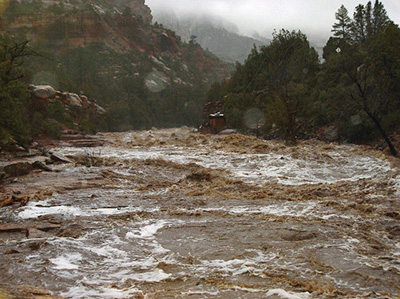 Flash Flood!! |
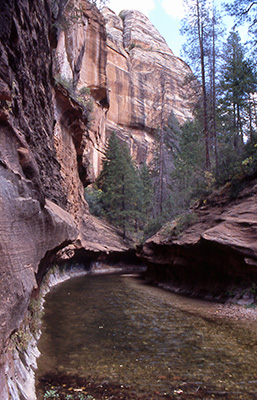 End of the line. |
End of the line. Trail’s end. A little over three miles into the canyon the trail simply dissolves into the creek, vanishing between the high canyon walls. Although the “trail” continues on for another nine miles before reaching the end of West Fork Canyon, most hikers turn back here and call it a day. I had suggested earlier that anyone interested should bring along sandals (mine were hanging at the ready from the back of my day pack), so we could do a little creek wading and exploring further up the canyon. However, any potential interest in that idea seems to disappear, along with the trail itself, once we reach this point. So, after a short rest break and a few pictures, we turn back and join the throngs of hikers returning to the trailhead. The mysteries that await us around the bend and into the amphibious unknown will have to wait for the next trip. |
 Top of Page
Arizona Trailblazers Hiking Club, Phoenix, Arizona
Comments? Send them to the AZHC .
updated September 21, 2015